
Wanderburg Mortar Tower Objective and Counter Guide
- Reviewed
- Scope
- Dated evidence; no installed-build testing
The Golden Dunes objective asking you to kill 25 Mortar Towers in one run appears to refer to an Overtime enemy, not every stationary structure that fires mortar rounds. Dated player reports from EA 0.9.6 describe the likely target as a castle-like tower with a large cannon set into the center of its top. Those players encountered it after defeating the final boss and entering Overtime.
That identification is useful but not definitive for the current Early Access build. The reports do not include a verified successful completion, a current target screenshot, or a guaranteed appearance schedule. Use the objective counter as the deciding test: record its value, destroy one candidate, and check whether the value increases before committing the rest of the run to that enemy type.
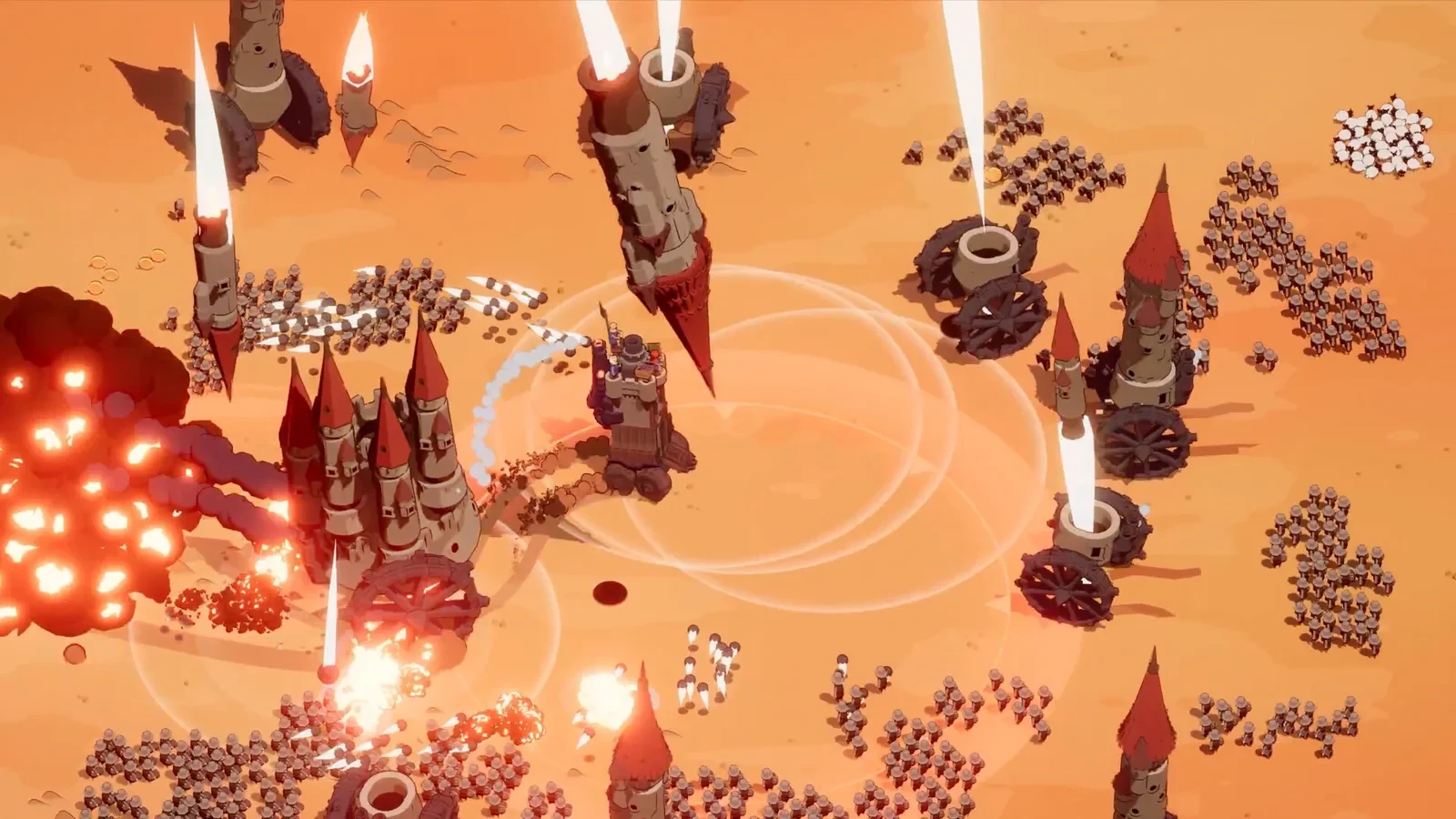
Open-barrel wheeled towers in a desert encounter. Use your objective counter to verify credit; appearance alone is insufficient.
Separate the three mortar-related targets
The word “mortar” can point to three different things during a run. Treating them as interchangeable is the main reason this objective becomes confusing.
| What you see | What it represents | How to treat it |
|---|---|---|
| Top Mortar in an equipment or upgrade choice | A module for your own castle | It belongs to your loadout and does not identify the enemy required by the objective. |
| A fixed tower, tall spire, or chest-bearing structure equipped with mortars | A stationary battlefield structure | Do not assume it qualifies because it fires mortar-like projectiles. An EA 0.9.6 player reported that single and double stationary mortar structures did not advance the counter. |
| A castle-like tower with a large cannon embedded in the top | The reported Overtime candidate | Destroy one while tracking the objective counter. Its appearance comes from a dated community description, so the counter must confirm it in your installed build. |
The older description tentatively mentioned tracks, but its author was unsure about the movement system. Tracks, legs, or any exact method of locomotion should therefore not be used as a required visual test. The stronger reported clue is the overall castle-tower shape and the oversized cannon positioned in the center of the top.
Do not identify the objective target only from its projectile. Stationary structures and the reported Overtime enemy can both look mortar-related during a crowded fight. The target’s silhouette, the phase in which it appears, and—most importantly—the counter response together provide a more reliable decision than the attack effect alone.
Use the objective counter as the deciding test
The objective counter is more useful than repeatedly destroying something that merely looks correct. Run a controlled check as soon as you find a plausible target.
- Read the complete objective wording. Confirm that you are tracking the Golden Dunes Mortar Towers objective and note the requirement to complete its kills in one run. A similarly named module or an unrelated mortar enemy is not enough.
- Record the displayed counter value. Check it before attacking the candidate. Do not rely on memory after a dense fight, especially if several structures are destroyed together.
- Isolate one candidate when practical. Choose a single castle-like mortar enemy rather than clearing several different tower types at once. A mixed group makes the result difficult to interpret.
- Destroy that candidate and inspect the counter again. If the number increases, you have direct confirmation for that run and installed version. Continue looking for the same enemy silhouette.
- Stop counting that structure if the number remains unchanged. Destroying more identical stationary towers is not a useful test once the first controlled kill has failed to register.
- Repeat the test when the phase or enemy changes. A tower found during the normal level and an Overtime Mortar may not represent the same objective entity even if their weapons look similar.
A counter increase proves that the defeated target qualified. It does not prove that enough additional targets will appear, that they follow a fixed interval, or that the objective will unlock correctly after the final required kill. Keep identification, availability, survival, and completion as separate checks.
If the counter does advance, concentrate on reproducing the confirmed target rather than widening the search to every cannon structure. Use the same visible silhouette and the same run phase as your working identifiers. If two targets look similar but only one advances the counter, the counter result takes priority over the shared mortar animation.
Reach Overtime without treating it as guaranteed completion
The EA 0.9.6 discussion provides a consistent historical clue: multiple players reported seeing the relevant Mortar Towers only after the final boss, in Overtime. The same discussion contains no confirmed route that produced all 25 required kills. Reaching Overtime should therefore be treated as access to the reported search phase, not as proof that the objective is now assured.
Use this sequence for the next attempt:
- Enter Golden Dunes with the Mortar Towers objective visible and record its starting value.
- Progress through the run normally instead of assuming stationary mortar buildings are accumulating hidden credit.
- If a stationary mortar structure is convenient to destroy, use one as a diagnostic test. Check the counter and reject that target type if it does not register.
- Defeat the final boss and enter Overtime if the run remains viable.
- Look for the reported castle-like tower with the large top-mounted cannon.
- Confirm the first Overtime candidate with a before-and-after counter comparison.
- Continue only with confirmed targets while preserving enough room to respond to their projectiles and surrounding enemies.
Do not plan around an exact spawn interval or a guaranteed count. The September 8 player reports disagree with the objective’s practical demands: players could find some candidates in Overtime, but they did not show a successful 25-kill completion. Waiting for a fixed number of minutes based on those observations would turn an uncertain report into an unsupported rule.
The one-run wording also changes the value of a failed identification. Kills from separate attempts should not be added together as if this were a cumulative account objective. A run that reaches Overtime but never produces a verified counter increase has diagnosed the problem; it has not made partial progress that can safely be assumed to carry into the next attempt.
Read the Mortar attack without relying on old timing
Official hotfixes changed Overtime after the original EA 0.9.6 reports. Hotfix 0.9.8 strengthened the Overtime Mortar and changed its projectiles to use faster, constant flight time. Later official notes for 0.9.13 adjusted Bronze and Silver Mortars in Overtime, while 0.9.14 adjusted Overtime enemy stun resistances.
These updates matter for two reasons. First, survival advice based on the earliest release build may no longer match the current projectile pressure. Second, none of those documented balance changes confirms that the 25-kill objective received a completion fix or a guaranteed spawn route.
Keep space around the candidate while identifying it. A clear view makes it easier to distinguish the large top-mounted cannon, follow incoming projectiles, and see whether the enemy has actually been destroyed. Avoid stopping in a dangerous firing lane merely to watch the objective text. Create distance first, then check the counter when the immediate attack has passed.
Do not use the old reports to predict an exact delay between appearances. Treat every confirmed candidate as an individual opportunity. If the next one does not appear quickly, continue managing the active Overtime threats rather than parking in place and waiting according to an unverified schedule.
The official news pages checked on October 9 include hotfix 0.9.14, published September 21, but that announcement does not prove which build is installed on your machine. Check the version shown by your game before comparing your result with an older report.
Diagnose what happened before starting another run
Different failures point to different next actions. Keep them separate so the next attempt answers one clear question.
| Result | What it establishes | Practical response |
|---|---|---|
| A stationary mortar structure dies and the counter stays unchanged | That structure did not qualify in this test | Stop farming identical structures and reserve the next check for a different target or run phase. |
| A castle-like Overtime Mortar dies and the counter increases | The target is valid for this run and version | Continue matching that silhouette and verify later kills against the same counter. |
| You reach Overtime but cannot identify a candidate | Access to Overtime alone does not locate the target | Preserve a screenshot of the battlefield and objective, then compare it with the reported large-cannon silhouette. |
| Confirmed targets appear but the run ends before the requirement is met | Identification succeeded, but availability or survival blocked completion | Do not report this as an objective bug unless the confirmed kills also failed to register. |
| A likely Overtime target dies and the counter remains unchanged | The historical identification may not apply, or the counter may be malfunctioning | Capture the target and counter state, verify the installed version, and prepare a precise bug report. |
| The final required confirmed kill appears to register incorrectly | The completion state is unresolved | Preserve the before-and-after counter evidence rather than claiming the unlock succeeded or failed without a visible result. |
This approach also prevents two opposite mistakes. The first is declaring the objective broken after attacking the wrong stationary structure. The second is assuming the objective works because Overtime Mortars exist, even though those player reports do not demonstrate a completed current-version run.
What to record when the counter does not change
A useful report needs enough detail to separate target confusion from a counter problem. Record the following during the same attempt:
- The complete objective wording and its displayed biome.
- The counter value immediately before the candidate is destroyed.
- The counter value immediately after the candidate is destroyed.
- A clear image of the target showing its tower body and top-mounted weapon.
- Whether the target appeared before or after the final boss.
- Whether the run was already in Overtime.
- The installed game version shown by the game.
- Whether the target was stationary or moving, without guessing about tracks or legs that were not clearly visible.
Do not describe the problem only as “Mortar Towers do not count.” State which structure was destroyed and which visible counter failed to change. That distinction lets another player or the developers determine whether the report concerns a stationary cannon structure, the reported Overtime Mortar, or a genuine objective failure.
Use this checklist on the next attempt
Before spending another long run on the objective, make sure each decision has a visible answer:
- The Golden Dunes objective is active and its one-run requirement has been read.
- The starting counter has been recorded.
- Top Mortar equipment is excluded from the target search.
- Stationary mortar structures are treated as unconfirmed until one changes the counter.
- Overtime is the reported search phase, not a guaranteed completion route.
- The first castle-like, top-cannon candidate is tested with a single controlled kill.
- Exact spawn intervals and guaranteed target totals are not assumed.
- A successful counter increase becomes the identification standard for the rest of that run.
- An unchanged counter produces screenshots and version details instead of repeated blind farming.
The most useful next step is therefore not another unrestricted attempt. Enter with the counter documented, test one normal-level structure if convenient, then perform the same controlled check on the first castle-like Mortar enemy found in Overtime. That sequence will tell you whether you have the correct target before the one-run requirement consumes the rest of the attempt.