
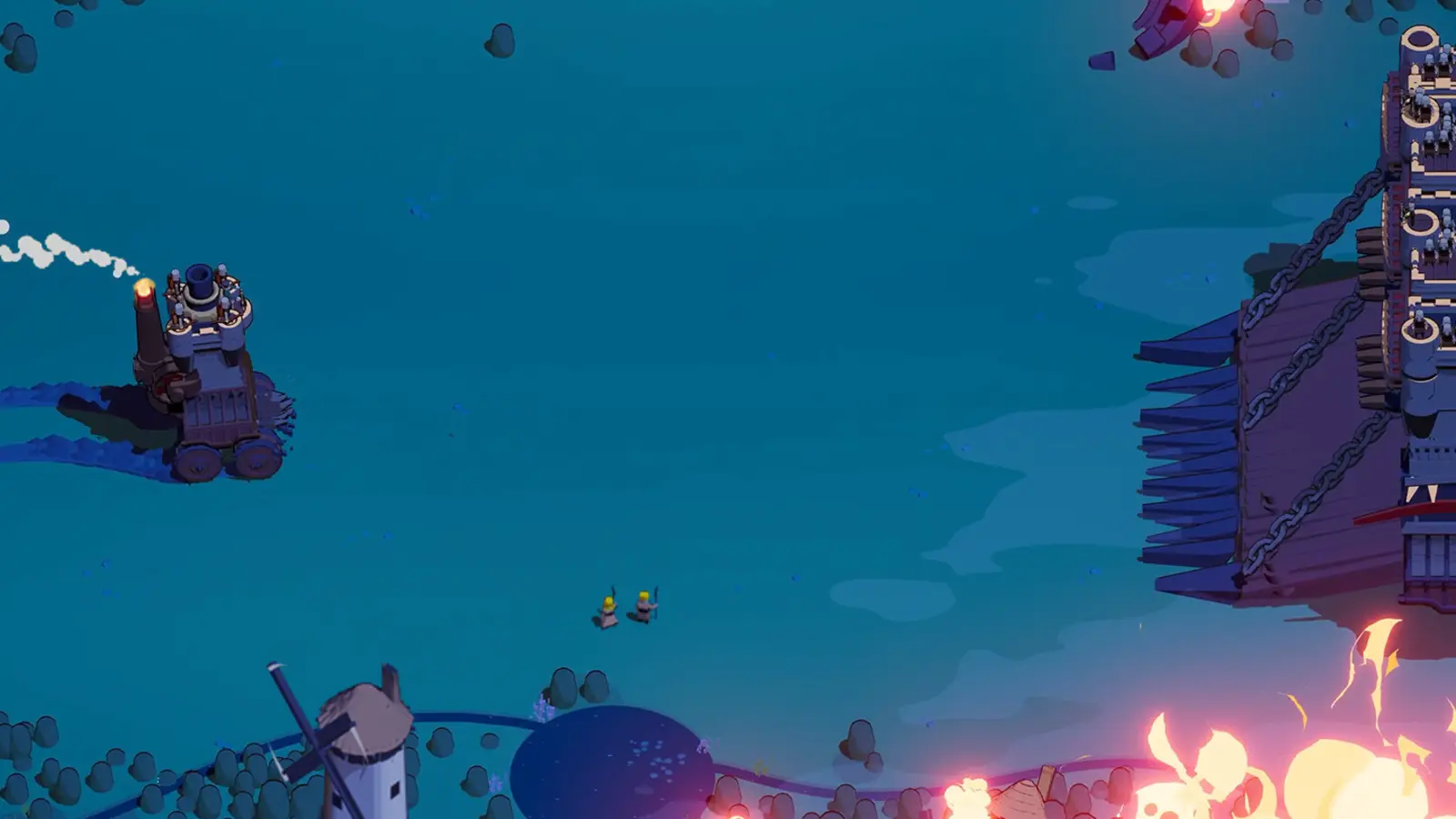
Read the attack before the upgrade
Use this reference to decide which part of a module needs attention. The examples distinguish automatic attacks, manually activated abilities, special selections, and permanent unlocks. The recommendations explain how to make a decision from the choices actually shown; they are not a fixed upgrade order or a damage calculator.
Reviewed:
A module can offer several useful upgrade directions without all of them helping your current run equally. Before choosing, look at what the card actually changes. Automatic attacks, active abilities and cooldowns do different jobs.
The module-selection interface below is also distinct from upgrading an equipped module. Adding another weapon expands your options; strengthening an existing attack makes the current plan more dependable.
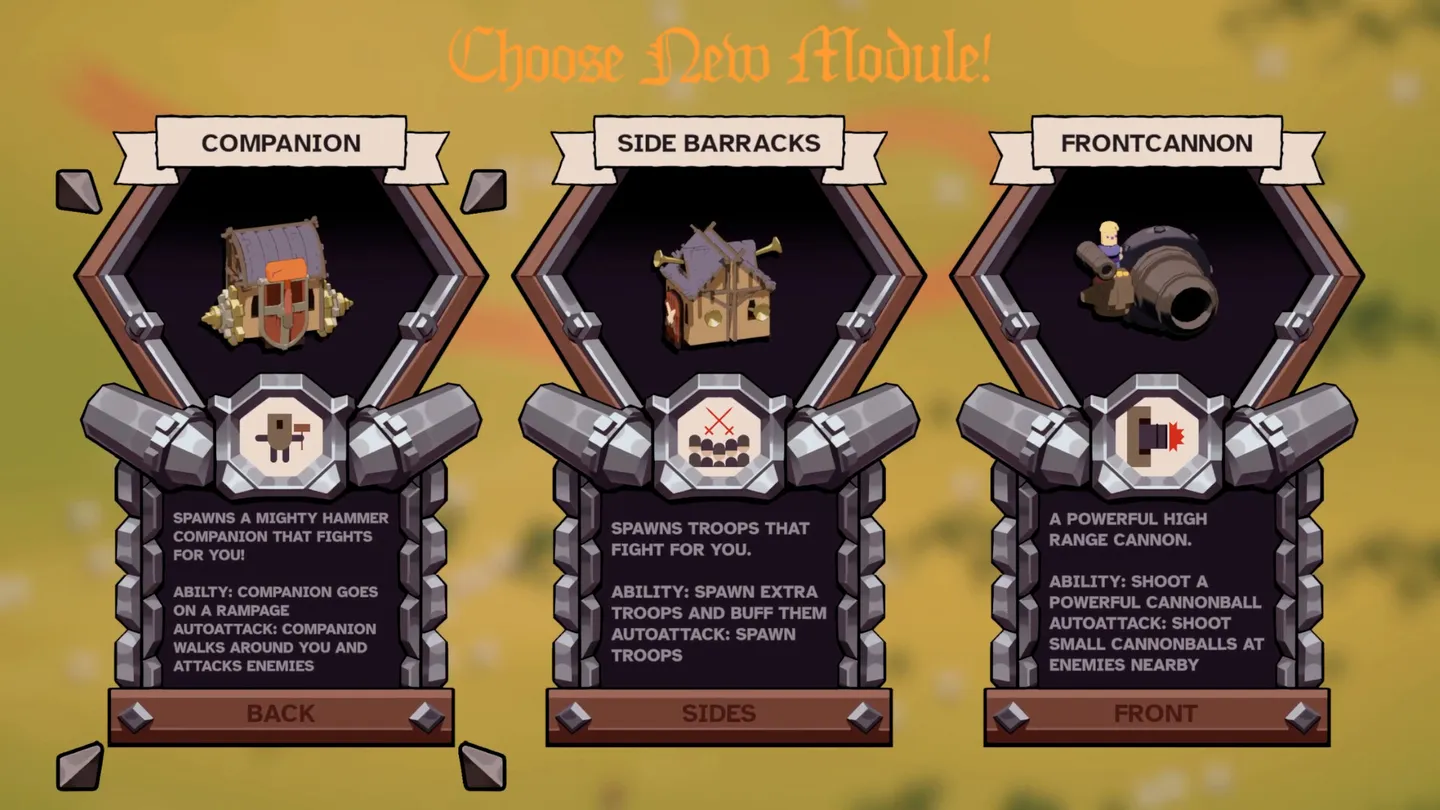
Choose the upgrade that changes the fight
| Situation | Useful direction to inspect | Why another option may disappoint |
|---|---|---|
| Small enemies wear you down while you steer | Automatic attack coverage or output | Active damage does little while that ability is unavailable |
| A boss survives each accurate burst | Active damage or a useful special choice | Cooldown alone cannot fix a burst that is too weak |
| Enemies arrive before the next deployment | Cooldown | More range may not solve the waiting period |
| Attacks pass beside the target | Position and firing angle first | More damage still misses |
| Health disappears despite good damage | Movement, recovery or defense | Another damage upgrade may not address the cause |
These are decision rules, not a fixed mathematical priority list. Card values and rarity can make a different choice better on a particular screen.
Read an upgrade card in a useful order
Start with the affected module, then identify the attack, then read the actual change. This order prevents a familiar icon from making the decision for you. A card associated with a cannon can improve its automatic shots, its active burst, or a property that changes how one of those attacks behaves. Those are different benefits even when the same weapon appears at the top of the card.
Next, compare the offered improvement with what happened during the last encounter. Did the automatic fire leave too many small enemies alive? Did the active attack hit the boss but fail to create enough room? Did you have the ability ready but never find a safe angle? Each answer points toward a different response. The first two may justify an offensive upgrade. The third asks for better positioning before a larger number becomes useful.
Finally, look at rarity and the magnitude of the change. A substantial improvement to a secondary module can be worthwhile, especially if that module is doing real work. Conversely, a high-rarity card can still improve an attack that contributes little to your present plan. This guide recommends comparing actual use rather than automatically refusing every off-plan card or accepting every brightly colored option.
Automatic attacks help when attention is elsewhere
Driving, avoiding projectiles, collecting resources, and deciding where to turn compete for your attention. Automatic attacks continue to matter during those movements. A player who consistently forgets to activate an ability should first learn that activation, but can also choose upgrades that improve the attacks already contributing throughout the encounter. That is a practical recommendation about use, not a claim that automatic builds are universally stronger.
Observe where enemies remain alive after your castle passes. If a weapon repeatedly leaves threats directly on your intended escape route, consider whether its coverage or output is the issue. An attack that fires frequently in the wrong direction may still leave the same gap. Avoid translating every crowded screen into a need for attack speed; firing direction, target position, and the rest of the loadout can matter just as much.
The recorded arrow-and-turret route illustrates a focused family of attacks, but its successful run does not supply a universal upgrade schedule. You can use that example to look for shared arrow support while still reading each module's own text. An effect that looks like lightning does not, on appearance alone, establish that a magic-specific bonus applies to the entire attack.
Active damage needs a reliable opportunity
An active ability is valuable only when you use it in a situation where its attack or deployment helps. With Side Cannons, positioning beside the target matters to the broadside. With a deployment, the place and moment you create the friendly unit can matter to its usefulness. A larger damage number is not a substitute for understanding the attack's direction or the space available around the enemy.
Before choosing several active upgrades in a row, try to describe your intended use in one sentence. For example: use the burst after gaining a clear side angle, or deploy support before moving away from a dangerous lane. If you cannot identify that moment, spend the next encounter learning the existing ability. This avoids building around a theoretical burst you never actually deliver.
Also distinguish difficulty using a button from a weak ability. If you are still learning the controls, an extra cooldown reduction may create more opportunities that you overlook. If you already activate reliably and the attack lands, then the offered damage, duration, projectile, or cooldown changes become easier to judge. The current card remains the authority for what the upgrade changes.
Cooldown is useful when waiting causes the problem
Cooldown upgrades make sense when a useful action is regularly unavailable. Watch for a repeated pattern rather than an isolated moment: the boss presents an opening, your attack is still recharging, and you have to survive another exchange. Reducing that gap can improve the way the build feels even when it does not increase the strength of an individual hit.
There is another possible pattern: the ability becomes ready while you are dodging, but stays unused because the firing angle is unsafe. A shorter cooldown does less for that situation. You may need to change your route or create more space before triggering the attack. The distinction matters because both situations can feel like the build is too slow, while only one is directly caused by recharge time.
Cooldown effects also deserve precise names. A reduction, a refund after a trigger, and a full reset are not interchangeable. The supplied gameplay contains several cooldown-related observations, but they do not establish that every effect stacks into an unlimited loop. For ordinary upgrades, judge the displayed change on its own before planning around an artifact interaction whose complete conditions you have not confirmed.
Concentration and coverage answer different problems
Concentrating upgrades on a core module can help it reach a useful special choice and maintain a clear damage plan. The Side Cannons progression example gives a concrete reason to care about an individual module's level: a recorded challenge ties level 10 to access to Front Cannon. If that is your objective, deliberately choosing relevant upgrades can support the objective instead of spreading selections without a plan. The separate permanent purchase check establishes when the new module is actually owned.
However, concentration is a recommendation with a limit. If your main weapon leaves a dangerous approach uncovered, improving a supporting module may help more than another small increase to the core. If the entire castle struggles to move out of incoming fire, a movement or recovery choice may be the important selection. Do not keep feeding one module merely because you decided before the run that every card must go into it.
Separate the objective you are pursuing from an imagined perfect finish. A challenge attempt might prioritize an upgrade threshold. A first clear might prioritize surviving the next boss. An experimental run might test a special option. Those goals can lead to different decisions on the same screen, so there is no need to force all of them into one published priority list.
Use special choices to change behavior deliberately
When a special option appears, read both what it adds and what it expects you to do. An active projectile change rewards a player who uses the active attack. A summon choice should be considered in the context of the units you are actually producing. Do not transfer a benefit from one summon source to every friendly unit without an explicit description establishing that scope.
After selecting a new behavior, give it a fair opportunity to work. If your attack now behaves differently, spend an encounter watching its path or timing rather than immediately concluding that the larger number should have won the fight. This is especially useful when changing from a familiar branch: the old movement habit may not exploit the new choice.
Early Access updates can change this judgment. Hotfix 0.9.9 adjusted both sides of Side Ballista, reducing its automatic attack and improving its active ability. That is a concrete reason not to inherit an old automatic-only priority unchanged. It does not establish that the active route wins in every build, but it does mean the two attack types should be reviewed separately in the current client.
Account for changes to the particular attack
Recent balance notes distinguish changes that a generic module ranking would hide. Hotfix 0.9.10 reduced the maximum attack-speed boost for Back Turret. That is a change to the upper end of a particular benefit, not a published new base attack speed or a reason to assign a numerical damage loss to every turret build. A late-run attack-speed observation from older footage should therefore be compared with the current behavior before being used as a target.
The same patch increased rarity-based damage for both the active and automatic attacks of Side Arm. Side Arm is a different module from Side Cannons and Side Ballista. Its change cannot be used to justify a new cannon priority simply because the names share the word Side. When a card feels different after an update, identify the full module name and the affected attack first.
Hotfix 0.9.9 also fixed diminishing-damage upgrades for Front Barracks and improved its active ability. That separates a corrected upgrade problem from a normal choice between competing benefits. If older footage describes an unexpected reduction, it may not represent the behavior you should expect after the fix.
Review an upgrade plan after a failed run
Use the last dangerous encounter as a short review. Identify which attack was available, whether it landed, and what ended the run. If the boss remained healthy despite accurate hits, output may deserve attention. If you were trapped while abilities were ready, positioning and space deserve attention. If health slowly disappeared between major fights, a plan that only improves burst damage may be addressing the wrong problem.
Then choose one adjustment for the next attempt. Keep familiar equipment while changing the upgrade emphasis, or keep the emphasis while practicing the active attack's angle. Changing the captain, chassis, modules, and upgrade plan together makes it harder to identify what helped. You do not need to assign invented damage scores to learn from a controlled comparison of your own attempts.
Record special choices by their actual text if you want to repeat the route. Color names, left-versus-right position, and memories of an icon are weak reminders when the game is changing. A repeatable plan states what the choice does, when you use it, and what limitation remains. That produces a useful upgrade route without pretending the random sequence will be identical next time.
Automatic output
Automatic attacks provide continuing coverage while you drive. Inspect whether the offered upgrade changes damage, attack timing, projectile count, or another explicitly named property. An automatic improvement is especially relevant when ordinary enemies repeatedly enter the space you need for steering. It does not automatically improve the manually activated attack, even if both attacks come from the same module.
Partially verifiedActive ability and availability
An active improvement changes the attack that you deliberately trigger. Damage matters when that attack lands but does not finish its target; cooldown matters when the attack is unavailable during useful opportunities. Before investing further, establish that you recognize its button and can aim or deploy it reliably. Faster availability is not equivalent to additional successful hits.
Partially verifiedSpecial selections
Special options can alter what a module does rather than merely raise a shared statistic. Recorded choices include projectile behavior and summon-related changes. Read the actual description and decide how it changes the next fight. Do not infer an identical branch tree, unlock level, or maximum level for all modules from one recorded weapon.
Partially verifiedUpgrade decisions in sequence
These routes are practical decision sequences, not timed combat combos. Frame values remain unknown because the archived gameplay does not provide controlled frame measurements. A route is useful only when its named problem matches the current run, and it should be reconsidered after equipment or enemy pressure changes.