
Wanderburg Review: A Clear Early Access Buying Verdict
- Reviewed
- Scope
- Dated evidence; no installed-build testing
Wanderburg is already a playable and distinctive action roguelike, but the safest buying decision depends on how much you value its immediate castle-driving fantasy over long-term variety. The current Early Access version has a complete run structure: steer a moving fortress, consume smaller targets, fight hostile castles, add modular weapons, choose upgrades, and unlock more strategic options between attempts. Its strongest qualities are the physical sense of growth and the freedom to assemble unusual combinations. Its main risk is repetition once that central novelty becomes familiar.
At the captured U.S. Steam price of $14.99 on October 9, 2026, Wanderburg is easiest to recommend to players who actively enjoy replaying compact systems while development continues. Players expecting a deep, fully polished progression game should wait for later Early Access updates. This assessment is based on the official store and update record plus dated post-launch player observations, not personal playtesting.
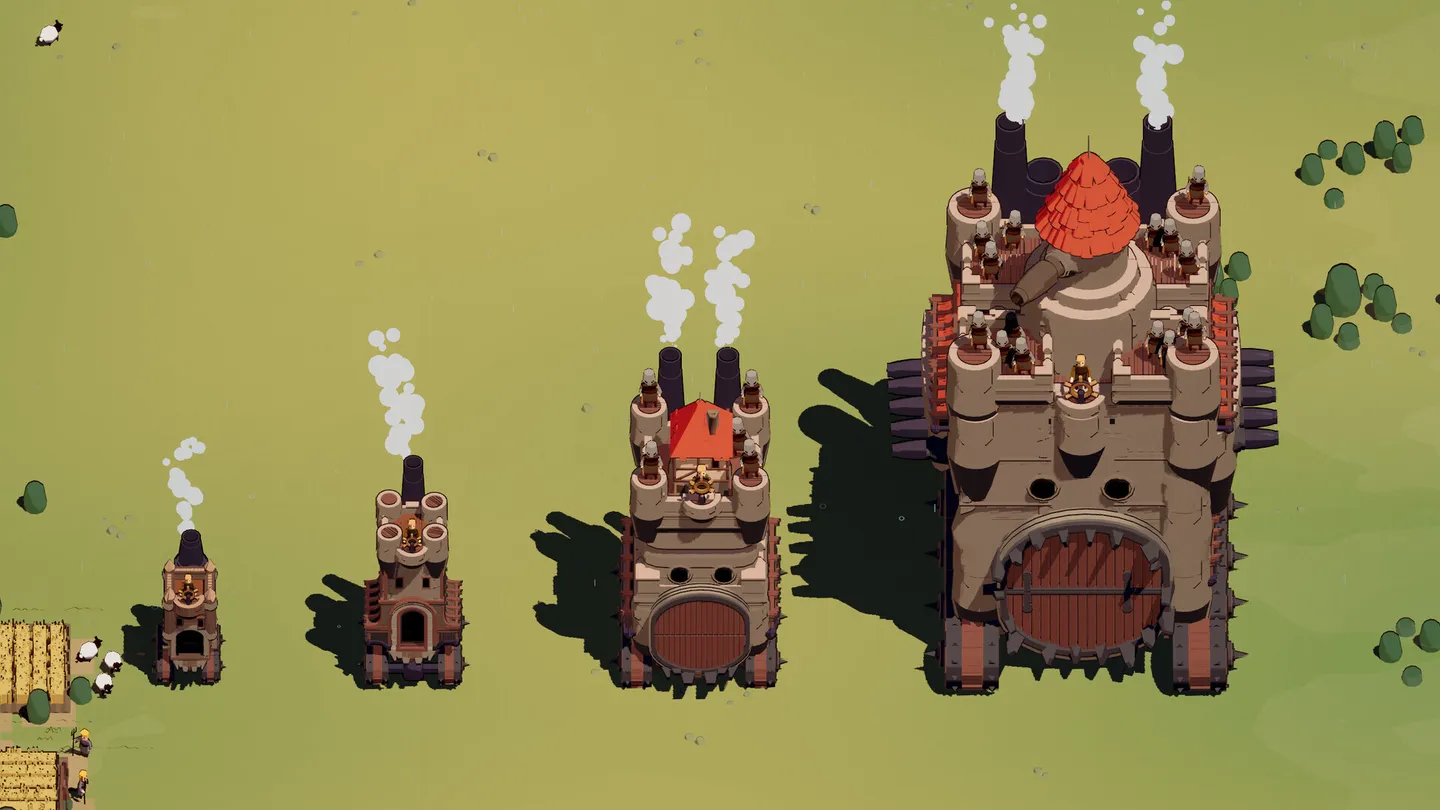
Growth changes the castle footprint through a run.
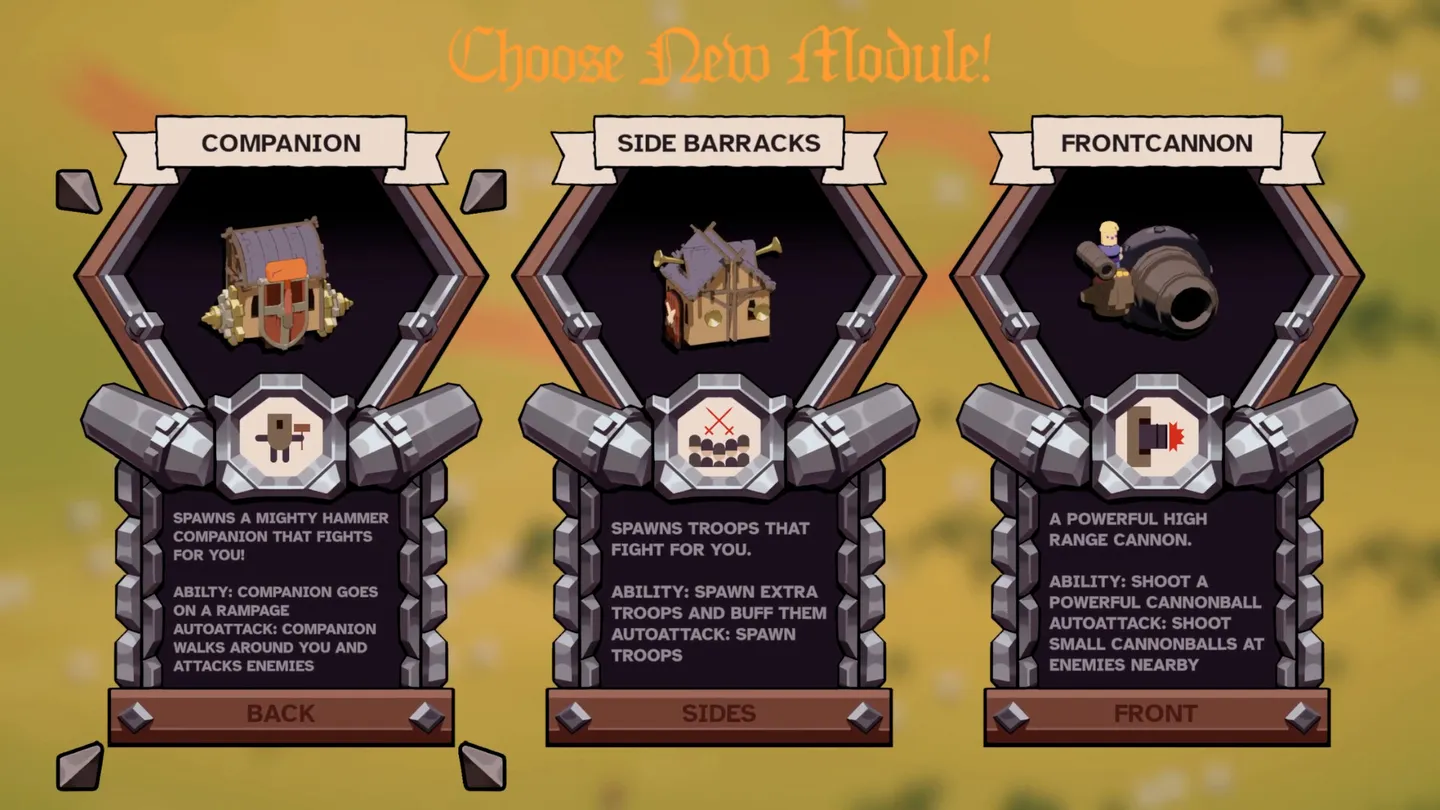
Slot labels and automatic/active descriptions explain how the modular arsenal changes play.
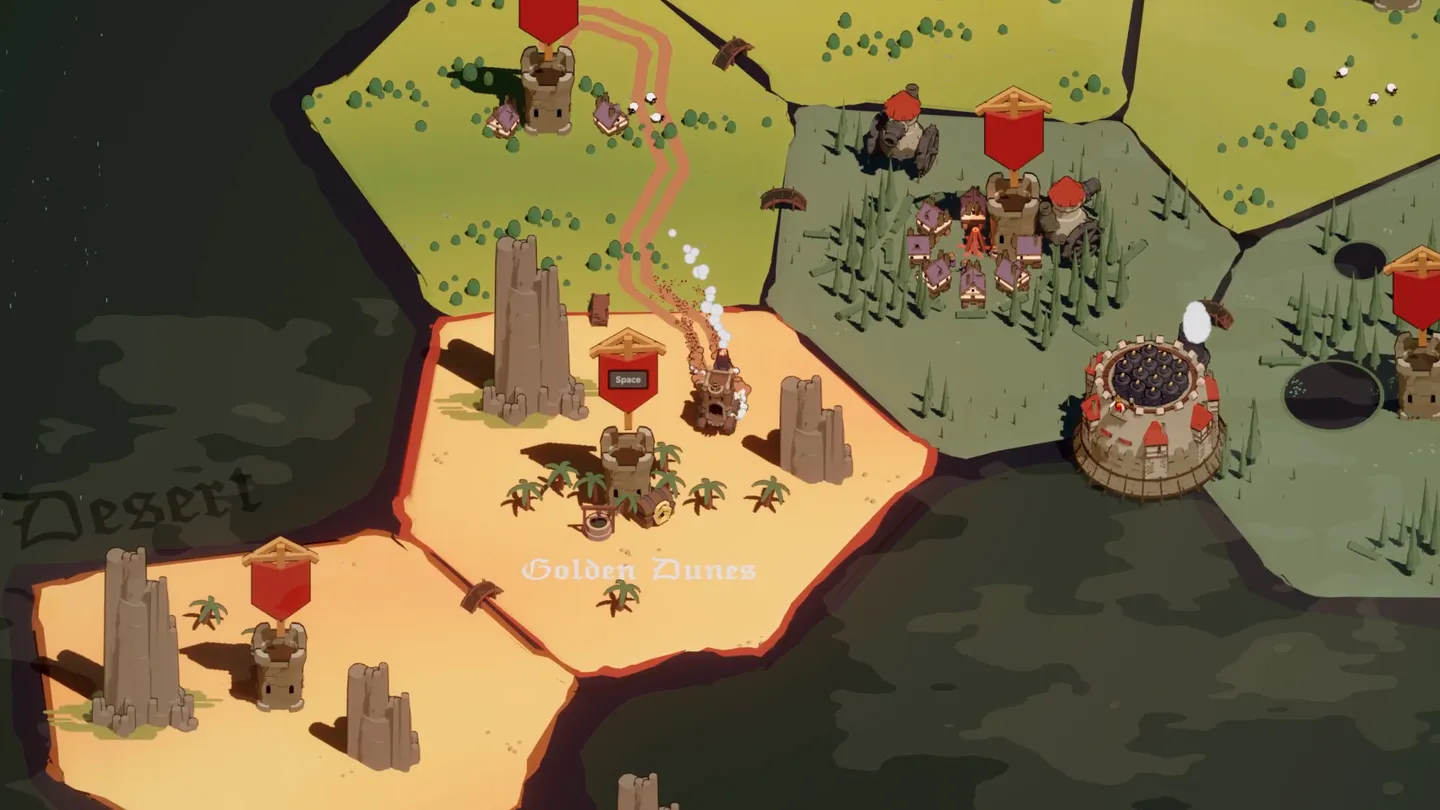
The overworld links separate run locations and progression decisions.
The Short Buying Verdict
Buy Wanderburg now if the idea of driving and enlarging a weapon-covered castle is itself enough to carry repeated runs. The official description supports several meaningful layers: multiple biomes and difficulty levels, consumable villages and fortresses, modular siege equipment, vehicles, artifacts, captains, and between-run unlocks. That is more than a bare prototype, and the developers describe the core loop as fully playable.
Wait if your enjoyment depends on a large amount of build depth, mature balance, extensive presentation options, or a clearly finished progression economy. Several early players praised the responsive central mechanics while separately questioning how long the available upgrade choices would remain interesting. That distinction matters: a satisfying run can coexist with uncertain long-term replay value.
| Your priority | Current assessment |
|---|---|
| A novel action-roguelike premise | Strong reason to consider buying |
| Immediate, readable castle growth | Central strength of the current game |
| Deep long-term build variety | The clearest reason to wait |
| Finished balance and presentation | Still subject to Early Access work |
| Solo play with controller support | Officially supported |
| Cosmetic bonuses or soundtrack | Optional Supporter Pack only; no gameplay advantage |
What the Current Early Access Version Contains
A run begins with a mobile fortress rather than a conventional character. You steer through the battlefield, consume villages, flocks, and smaller fortifications when possible, and destroy stronger moving castles. Growth is both mechanical and visible: the fortress expands as the run advances, the camera can pull back to accommodate its larger form, and new weapons occupy different mounting positions around the vehicle.
The arsenal mixes medieval and deliberately absurd machinery. Official material shows cannons, arcane towers, explosives, and deployable structures, while progression between runs opens additional modules, vehicles, artifacts, and captains. Weapons combine automatic attacks with active abilities, so driving is not the only input demanding attention. Positioning, avoiding incoming fire, using abilities, and deciding which offered upgrade supports the current setup all happen during the same run.
The current package also extends beyond a single fixed challenge. The developers state that Early Access includes different biomes across multiple difficulty levels. Boss fights, Overtime, artifacts, rerolls, and leaderboards are all reflected in the official update record or store features. Steam lists 26 achievements, although an achievement count should not be mistaken for a measure of campaign length.
The Loop in Practical Terms
The appeal rests on a clear sequence: consume weak targets, gain resources and experience, expand the fortress, attach or improve modules, defeat stronger enemies, and carry unlocked options into later attempts. Individual player footage also shows choices between durability-oriented and mobility-oriented growth, plus artifacts that can encourage particular module interactions. Exact balance values from that footage may no longer apply, so they should not be treated as permanent recommendations.
The important purchase question is therefore not whether Wanderburg has systems. It does. The question is whether you enjoy repeatedly recombining those systems while chasing harder stages, objectives, scores, and unlocks. The game is built around iteration rather than a one-time narrative journey.
What Wanderburg Already Does Well
The moving-castle concept is not merely a visual wrapper. Driving changes how an otherwise familiar bullet-heaven structure feels. Momentum, turning, boost use, attack direction, and module placement make the fortress behave more like a vehicle than a character with a decorative skin. Growing large enough to consume targets that previously required combat gives progression a concrete battlefield consequence.
The modular layout also creates understandable tradeoffs. A weapon mounted at the front, side, top, or rear changes how comfortably it can contribute while the fortress is moving. Active abilities add another layer beyond passive projectile output. This makes a run legible even when many enemies and effects are on screen: the player can connect a chosen module or upgrade with a visible change in how the castle fights.
Dated post-launch observations consistently separate this strong mechanical foundation from concerns about content depth. One detailed player review described the gameplay loop as satisfying and the controls as enjoyable even while criticizing progression and polish. Reddit comments similarly ranged from players calling it highly enjoyable to others finding the early experience too easy or repetitive. Those are subjective reports, but their agreement on the basic feel is useful: the premise appears to work, while its staying power varies substantially by player.
Official platform features reinforce the pick-up-and-play side. Wanderburg supports mouse, keyboard, and controllers, with full Xbox and PlayStation controller support listed for the PC version. Steam also lists adjustable difficulty, save-anytime support, custom volume controls, and options to play without quick-time events. Steam Deck status is Playable rather than Verified, so handheld buyers should not interpret the listing as a guarantee of a completely frictionless Deck experience.
Where the Early Access Limits Matter
The largest concern is progression depth. Early player observations describe an exciting central mechanic paired with upgrade choices that can begin to feel shallow. Another recurring concern is that unlock costs or resource gains can make progress feel grind-heavy. These comments were made around the launch period and should be treated as dated experiences, not fixed facts about every later build. They still identify the right risk to evaluate before buying: Wanderburg asks for repeated runs, so a progression system that feels too narrow or slow will affect its value more than a minor visual flaw.
Presentation was another criticism in one post-launch review. The player reported a sparse options menu, limited graphics controls, unclear parts of the stage-selection interface, and a low-quality menu background video. These are observations from a particular version and device, not promises about the current installed build. They are relevant because the official roadmap explicitly says performance, stability, content, variety, and polish remain active development priorities.
Difficulty impressions are also inconsistent. One player refunded after finding an early run too easy, while another response said later difficulty tiers became demanding. The official store confirms multiple difficulty levels but does not establish a universal difficulty curve. A fair expectation is that the opening experience may not demonstrate the full challenge, yet access to harder content does not automatically solve concerns about repetition.
The captured Steam review data provides a broader but still imperfect signal. On October 9, English reviews were listed as Very Positive at 80% of 1,145 reviews, while recent reviews across languages were Mostly Positive at 76% of 2,711. That spread supports a cautiously favorable verdict rather than an unqualified recommendation. Review percentages can change, and they do not explain whether a specific buyer values novelty, difficulty, or long-term progression most.
The Official Update Position
Wanderburg entered Early Access on September 8, 2026. The store capture displays Hotfix 0.9.14, dated September 21, as the latest regular update. Its announced changes included improved boss fights, a second artifact reroll, Electric Mage buffs, stability work, balance adjustments, and bug fixes. This confirms active post-launch iteration, but it does not prove which build is installed on any individual computer.
The September 30 roadmap announcement is the newer official communication. It plans to share a deeper update during Q4 2026 and targets a larger content-focused update in Q1 2027 while continuing performance and stability work. The roadmap is described as a rough overview, so it should not be read as a detailed feature commitment. The developers estimate six to twelve months in Early Access, with explicit room for that schedule to change according to development and feedback.
This creates a straightforward tradeoff. Buying now gives access to the established core loop and lets the player follow its evolution. Waiting reduces the risk that current concerns about variety, progression, or interface polish will dominate the experience. There is no need to purchase now merely because of the Early Access estimate; the developers also state that the price might rise as content and features are added, but no future price or date is guaranteed.
Platform, Price, and Edition Checks
The supported desktop operating system is Windows 10 or later on a 64-bit processor. Minimum requirements list a 10th-generation Intel Core i5, 4 GB RAM, an Nvidia GeForce GTX 1660 Ti, DirectX 11, and 2 GB of storage. The recommended section supplies DirectX 12 but not a complete second hardware configuration, so buyers should not invent a recommended CPU, GPU, or memory target from the minimum list.
The game is officially single-player. Steam Cloud, Achievements, Stats, Leaderboards, and Family Sharing are listed. The leaderboards represent score competition and do not establish cooperative or competitive multiplayer.
The base game was captured at $14.99 on the U.S. store. The $5.99 Supporter Pack requires the base game and adds the soundtrack by Tumult Kollektiv plus four pirate-themed decorations: a companion boat, steering wheel, skull figurehead, and flag cabin. It is explicitly cosmetic and supplies no gameplay advantage. Anyone evaluating gameplay value should judge the base game by itself; the DLC is only for the soundtrack, decorations, or direct support.
Buy Now or Wait
Buy now if all three statements fit: you want a solo action roguelike, the mobile-fortress premise is the main attraction, and you are comfortable with a game whose variety and balance are still being expanded. The current version already supports complete runs, escalating difficulty, modular experimentation, persistent unlocks, bosses, Overtime, and score chasing.
Consider waiting for the planned Q1 2027 content-focused update if your decision depends on broader long-term variety; that target may change. Wait for later polish if limited graphics settings, interface roughness, or uncertain performance on hardware near the minimum specification would be especially frustrating. Players who only want a finished progression economy should wait for clearer evidence from later updates rather than assuming the current Early Access plan will resolve every concern on a particular schedule.
Before purchasing, compare the minimum PC specification with the actual machine, confirm that solo play is acceptable, and decide whether repeated build experimentation is enjoyable without requiring a finished campaign. Buy only the base game for gameplay. Then reassess the official update notes when the planned content-focused update is released; that is the most useful future checkpoint for buyers whose main hesitation is depth rather than the core driving and combat concept.